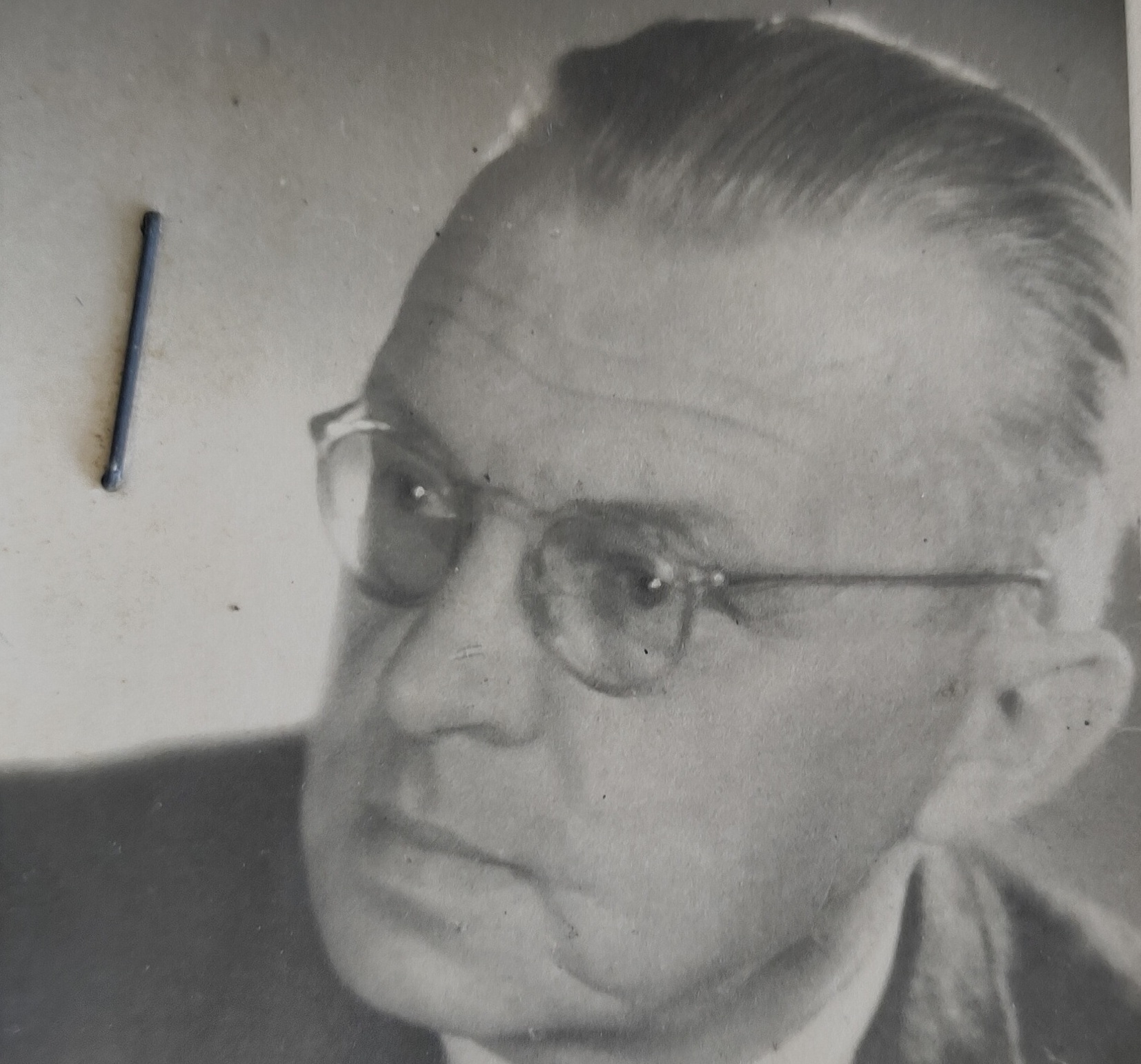
Profile
Erich Geldner was born in Opava to builder Alois Geldner and his wife Marie, née Brumovská. From 1910 to 1918, he studied engineering in Vienna, though his studies were interrupted by military service (1909–1910, 1914–1918). In 1921, he married Elsa Lindner (1897–1988), daughter of the Jewish merchant Leopold Lindner from Opava. The couple had no children.
After his studies, Geldner joined the family construction company, which he took over after his father’s death in 1923. By 1925, he had become its sole owner. He lived in house no. 432 in the Jaktař suburb. While he was a creative architect, his company also frequently undertook public contracts and carried out designs by other architects. Among the most significant were the reconstruction of the Breda & Weinstein department store based on a design by Leopold Bauer (1927–1929), Erwin and Fritz Käufler’s residence at Dolní schody Street 8 designed by Bauer’s son Harald (1931–1933), the Franciscaneum nursing school designed by Karel Gottwald (1928–1930), as well as
Gottwald’s own villa (1929–1930), Hans Kalitta’s villa (1927), and the building of the Silesian Gardeners’ Association at Hradecká Street 51, also by Gottwald. Geldner often collaborated with Otto Reichner, for instance on the municipal outdoor swimming pool complex (1929–1931), the villa for August and Erich Lassmann (1931–1932), and the Niedermeyer Café (1933). His first architectural project was likely the renovation of the Wladimir Demel house (Tyršova Street 20), where he lived at the time. He continued to design residential buildings throughout his career — notable examples include the Villa Olga for engineer Franz Koschatka (1926), a villa for director Ernst Gebauer at Hradecká Street 52 (1931), the residential building for the Theiner family at Rooseveltova Street 33 (1934), and the residential complexes on Rybova Street (nos. 14, 16, 18, 20, 22, 24) and Sluneční Street (nos. 11, 13, 15, 17) in the Nová Jaktař neighbourhood (1931–1936). He also designed several unrealized projects, including a villa for Walter and Else Zohner and a semi-detached house for the Freissler and Weisshuhn families.
Geldner also designed technical buildings, such as the Drechsler printing house at sady Svobody (Svobody Park) (1930), the electrical current converter station at Rybí trh (Fish Market) (1929–1931), the extension of the J. Stanke company’s production hall at Republic Square 2 (1930), a planned (but unrealized) bicycle and sewing machine factory for the same company, and the garage complex for G. Günther (1935).
In the second half of the 1920s, Geldner focused on remodelling façades and ground-floor commercial spaces of historic buildings in the city centre. Unfortunately, most of these alterations have not survived. Noteworthy examples include the renovations of buildings owned by Karl Steuer (Horní náměstí / Upper Square 27), Gustav Schäffner (Horní náměstí 30, demolished), Paul Weinkopf (Horní náměstí 11, demolished), Hansel’s Café (Horní náměstí 37, demolished), and the neighbouring Girschek department store (Horní náměstí 38), during which he incorporated newly uncovered Renaissance sgraffito. He was also responsible for the reconstruction and extension of the Herrmann & Vogel department store (Hrnčířská Street 1 and 3), and for alterations to the Huppert department store (Hrnčířská Street 10 and 12). These adaptations of older buildings also include the insertion of two offices into the attic of the western wing of the Chamber of Commerce, along with roof modifications and a dormer addition (Nádražní okruh Street, 1931, 1936), as well as the conversion of the convent of the Congregation of the Sisters of Mercy of the Third Order of St. Francis on Kylešovská Street (1928–1929).
Geldner was also active in public life. He was a member of the Silesian Construction Cooperative, worked as a court-appointed expert and assessor, and was politically engaged — representing the German Democratic Party in the city’s planning commission. During the Nazi occupation, in order to continue managing his company and, more importantly, to protect his Jewish wife, he joined the Sudeten German Party (SdP) in March 1938 and formally divorced Elsa for appearances. Nevertheless, he secretly supported her financially throughout the war. During this time, a loyal associate, Viktor Götzl, was installed to manage the company under the pretence that it was a Jewish business. After the war, Geldner was briefly interned in a labour camp, where he served as head of the technical office and drew up plans for the barracks. Thanks to testimony of his wife — who had returned from exile after living under a false identity in Budapest — and her documentation of his anti-fascist activity, he avoided expulsion and was allowed to remain in Opava. Although he regained Czechoslovak citizenship in 1950, his company had already been placed under national administration in 1945 (with Ludvík Žídek, a builder and architect, appointed as trustee). In 1948, the company was absorbed into the Czechoslovak State Construction Company, a national enterprise headquartered in
Prague, under the Opava division for civil engineering. In 1951, it was liquidated. Geldner continued working there as an architectural designer.
Erich Geldner’s architectural style evolved from historicist influences in his early work to decorative styles and German regionalism associated with the so-called “poetics of home” (Heimatstil) in the 1920s, eventually embracing modern rationalism and Neue Sachlichkeit (New Objectivity) in some of his designs from the 1930s. His residential and villa designs, tailored to the tastes of Opava’s middle class, were often inspired by Viennese modernism and neo-Biedermeier. They share certain recurring features, such as hipped roofs, cylindrical bay projections, and classical-style columns.
RR
Selected projects
Completed projects:
• renovation of the Hermann & Vogel department store, Hrnčířská Street 282/1 and 121/3, Opava-City, 1928
• villa for Franz and Olga Koschatko, Gudrichova Street 1393/26, Opava-Suburbs, 1925–1926
• remodelling of Bernhard Huppert’s department store, Hrnčířská Street 270/10 and 271/12, Opava-City, 1928–1929
• reconstruction of the Convent of the Congregation of the Sisters of Mercy of the Third Order of St. Francis, Kylešovská Street, Opava-Suburbs, 1928–1929
• electrical current converter station, Rybí trh (Fish Market), Opava-City, 1929–1931
• reconstruction of J. Stanke’s department store, construction of production hall and warehouse, náměstí Republiky (Republic Square) 198/2, Opava-Suburbs, 1930
• Drechsler Printing House, sady Svobody (Svobody Park) 448/4, Opava-City, 1930
• villa for Ernst and Hermina Gebauer, Hradecká Street 1815/52, Opava-Suburbs, 1931
• renovation of the house of Gustav Schäffner, Horní náměstí (Upper Square) 151/30, Opava-City, 1931 (demolished)
• residential complex, Rybova Street 1873/14, 1778/15, 1832/18, 1515/20, 1779/22, Opava-Suburbs, 1926–1932
• residential complex, Sluneční Street 1988/11, 1989/13, 2013/15, 2037/17, Opava-Suburbs, 1936–1938
• residential building for Gustav a Josefina Theiner, Rooseveltova Street 1940/33, Opava-Suburbs, 1934
• residential buildings, Stojanova Street 2031/7, 2015/9, Opava-Suburbs, 1937
• rental apartment buildings, Jurečkova Street 20/2032, Rooseveltova Street 2016/15, 2027/17, Opava-Suburbs, 1937–1938
• rental apartment building, Hany Kvapilové Street 2121/16, 2073/16a, Opava-Suburbs, 1937
• villa for Karl a Mizzi Steuer, Heydukova Street 2084/5, Opava-Suburbs, 1938–1939
• residential building for Guido Malý, Lidická Street 723/3, Opava-Suburbs, c. 1938
Completed projects outside Opava:
• Ostrava-Radvanice, Vrchlického Street 401/5, Czech Boys’ and Girls’ Civic School of František Sokol Tůma, 1925–1926
• Hradec nad Moravicí – Žimrovice, clubhouse in the grounds of the Karel Weisshuhn & Sons paper mill, 1926
Sources
References
-
Romana Rosová – Martin Strakoš (eds.), Průvodce architekturou Opavy, Ostrava 2011, p. 326.
-
Pavel Šopák, Erich Geldner – domy pro Opavu, Časopis Slezského zemského muzea, série B – vědy historické, 50, 2001, p. 74–91.
-
Jindřich Vybíral, Opavští architekti a stavitelé v letech 1918–1938, Časopis Slezského muzea, série B – vědy historické, 37, 1988, p. 258–265, zde s. 261.
-
Jindřich Vybíral, Opavská architektura v letech 1918–1929, Časopis Slezského muzea, série B – vědy historické, 35, 1986, p. 166–184.
-
Jindřich Vybíral, Opavská architektura v letech 1930–1938, Časopis Slezského muzea, série B – vědy historické, 36, 1987, p. 257–276.